
Reading time: 8 minutes · Last updated: September 21, 2026.
Under the porticoes near Piazza Santo Stefano, a bar owner is stacking crates of Lambrusco before opening while a street sweeper works the arcade in slow, even passes. Nearby, a delivery scooter idles outside a bakery, its rider waiting on a tray of tigelle. This is Bologna before the day-trippers arrive, and it is a very different city from the one most visitors photograph in an hour. Bologna off the beaten path is not really about finding secret sights, since the loveliest parts of this city are hiding in plain sight, under kilometers of arcades that most tourists walk straight past. You just have to slow down enough to notice them.
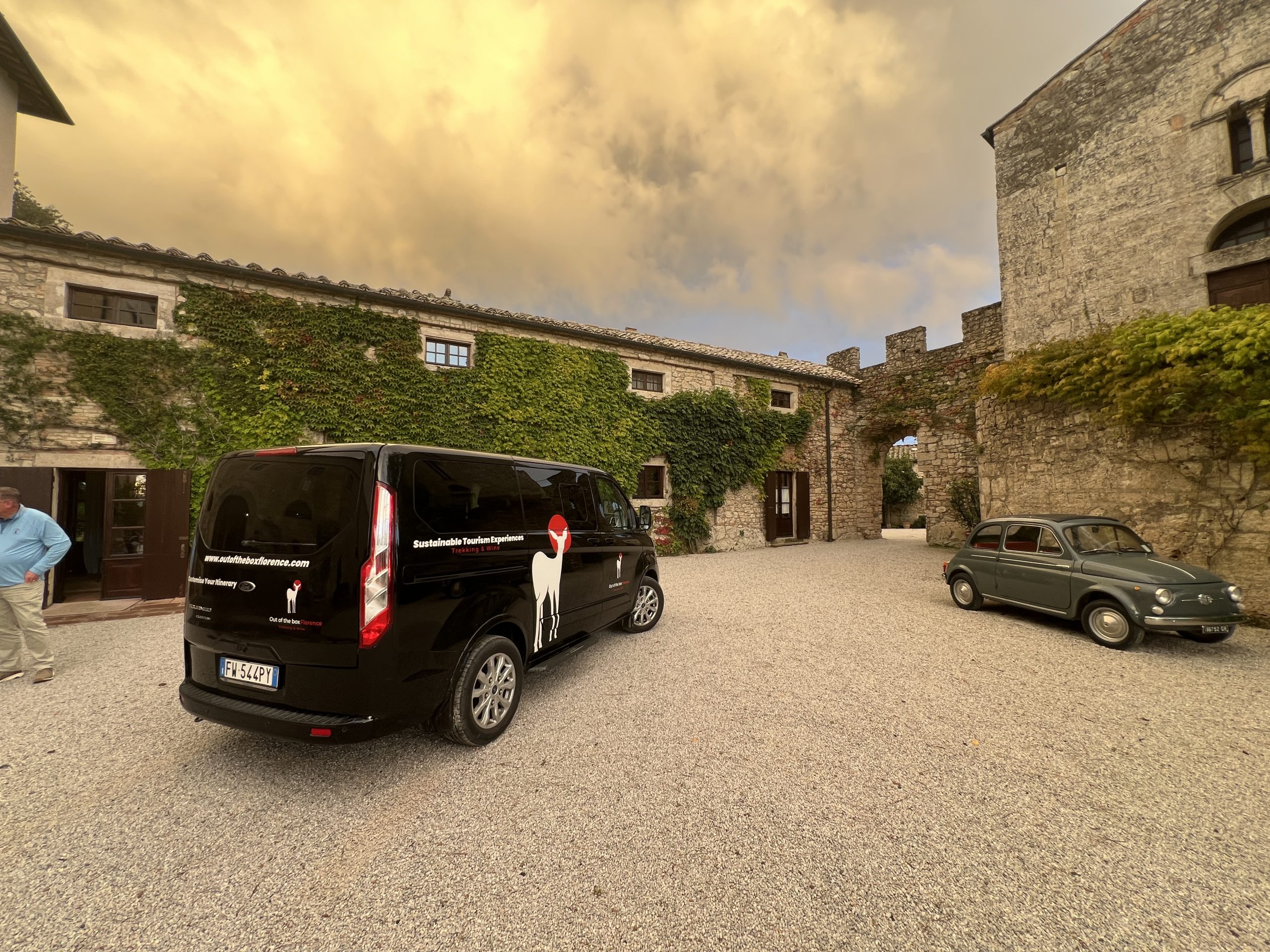
We’re Out of the Box Florence, a locally run tour company based just up the rail line in Florence. This is roughly how we’d spend a slower day in Bologna ourselves.
Why Bologna Off the Beaten Path Beats the Tower Queue
Bologna’s two leaning towers, Asinelli and Garisenda, have been closed to the public since October 2023, after engineers found the Garisenda was tilting further than expected. Consequently, the climb that used to top every itinerary is currently off the table, with stabilization work likely to continue for a couple more years. Rather than treat that as a loss, it is a reason to look elsewhere, since the towers were only ever one piece of a much larger city.
Because Bologna sits just 35 minutes from Florence by high-speed train, with departures running several times an hour, it works naturally as a slower counterpoint to a Tuscany-based trip. Travelers who already favor walking Florence on foot over coach tours tend to take to Bologna quickly, since the whole city rewards the same unhurried approach.
Quick fact: both of Bologna’s Two Towers have been closed since October 2023 for stabilization work, with no confirmed reopening date yet. Plan the visit around the porticoes, market, and neighborhoods instead.
Bologna Off the Beaten Path Starts Under the Porticoes
Bologna’s porticoes were inscribed as a UNESCO World Heritage site in 2021, and the numbers explain why: roughly 62 kilometers of covered walkway in total, with about 42 kilometers inside the historic center alone. They are not a tourist backdrop but working infrastructure, built over ten centuries so residents could move through the city protected from rain and summer sun alike.
Instead of photographing the porticoes near the main piazza and moving on, follow one for its own sake. Pick a residential stretch away from the shops, and you will pass doorways, shuttered windows, and the odd bicycle leaned against a column rather than another gift shop. That is where the arcades actually earn their UNESCO listing.
The Quadrilatero: Bologna’s Real Market, Not a Tourist Set
Just east of Piazza Maggiore, the Quadrilatero is Bologna’s medieval market district, and its narrow lanes still follow the original Roman street grid. Street names reveal what each lane once sold: Via degli Orefici for goldsmiths, Via Pescherie Vecchie for the old fish stalls, Via Drapperie for cloth merchants.
Unlike a market rebuilt for visitors, the Quadrilatero has been continuously trading since the Middle Ages, and residents still shop there daily alongside anyone passing through. Early morning is best, before the lanes fill up, when you can watch stallholders arrange produce and hear more Bolognese dialect than English.
Nine Centuries of Student Life, Bologna Off the Beaten Path
The University of Bologna was founded in 1088, making it the oldest university in the Western world, and it still shapes the city today with around 85,000 students spread across its schools. As a result, the streets around Via Zamboni feel entirely different from the postcard center: cheap bike shops, secondhand bookstores, and walls layered with decades of student posters and political stickers.
This university quarter rewards aimless wandering more than any checklist. Duck into the courtyard of the Archiginnasio, the university’s former main building, or simply follow the noise of a student bar spilling onto the street on a weekday evening.
Walk to San Luca the Way Locals Do
The Sanctuary of San Luca sits on a hill above the city, connected to the center by the Portico di San Luca, the longest portico in the world at roughly 3.8 kilometers and 664 arches. Built between 1674 and 1793, it climbs steadily from Porta Saragozza to the sanctuary itself.
Most visitors skip it entirely, assuming it is only for pilgrims, though it is really a proper uphill walk with a payoff view over the city and the Apennine foothills beyond. Along the way, the arcade shelters walkers from sun and rain exactly as it has since the 18th century, which makes it a comfortable climb in most weather. For travelers who enjoy building a trip around hiking and slower outdoor days rather than another museum queue, the San Luca climb fits right in alongside a Tuscany-based itinerary.
Bologna Off the Beaten Path: Neighborhoods Where Locals Live
Beyond the historic center, a handful of neighborhoods show a side of Bologna that rarely makes a highlight reel. Bolognina, north of the train station, grew up as a working-class railway district and has since become known for street art, small multicultural food shops, and reclaimed public space. Cirenaica, on the east side, stays quiet enough that few tourists ever wander in, which is exactly its appeal.
Meanwhile, Via del Pratello, an arcaded street roughly 600 meters long on the western edge of the center, fills up in the evening with a younger, bohemian crowd heading out for aperitivo. None of these areas are polished for visitors, and that is precisely the point.
Eating Like a Local, Not Like a Tour Group
Bologna anchors Emilia-Romagna, one of Italy’s most serious food regions, and it shows in small details: a queue of locals at a lunch counter, a handwritten daily menu with no translation, a pasta shop rolling dough in the front window. Tortellini in brodo and tagliatelle al ragù both trace back to this city, so it is worth seeking out a kitchen that treats them as a daily staple rather than a tourist checklist item. Even a simple mortadella sandwich, bought from a market stall rather than a restaurant, often turns out to be the best bite of the day.
If Bologna is one stop on a longer Tuscany trip, the same instinct applies back in Florence: skip the laminated menu near a major sight, and look instead for the kind of place locals actually use. Our Florence Off the Beaten Path: From Real Locals map applies the same principle to the Florence side of the trip.
Practical Tips for Bologna Off the Beaten Path
A little planning keeps the visit unhurried rather than rushed.
- Do not plan around climbing the towers; both Asinelli and Garisenda remain closed during ongoing stabilization work, with no confirmed reopening date yet.
- Book the fastest Florence–Bologna trains in advance during shoulder season, since frequent departures still sell out on weekends.
- Wear proper shoes for the San Luca portico, since the climb is steady and covers real elevation, not a flat stroll.
- Visit the Quadrilatero market before mid-morning, when it still feels like a neighborhood market rather than a photo stop.
- If you only have a day, pick two neighborhoods rather than trying to cover the whole center; Bologna rewards lingering more than checklists.
Overall, the goal is the same one that applies across Tuscany and Emilia-Romagna alike: fewer stops, more time actually spent in each one.
Frequently Asked Questions
Is Bologna worth visiting if the towers are closed?
Yes. The towers are one attraction among many, and the porticoes, Quadrilatero market, university quarter, and San Luca portico are all fully open and arguably more rewarding for a slower visit.
How do I get from Florence to Bologna?
High-speed trains connect Florence and Bologna in as little as 35 minutes, with several departures every hour from Firenze Santa Maria Novella, making it an easy day trip or standalone stop.
What is the best way to see Bologna off the beaten path?
Walk the porticoes away from the main piazza, spend time in neighborhoods like Bolognina or Cirenaica, and treat the Quadrilatero as a real market rather than a photo stop. A slow morning beats a rushed checklist here.
Is the Portico di San Luca difficult to walk?
It is a steady uphill climb of roughly 3.8 kilometers, so it takes reasonable fitness and proper shoes, though no technical hiking experience. Most walkers manage it in under an hour each way.
When will the Two Towers of Bologna reopen?
There is no confirmed date. Both towers have been closed since October 2023 for stabilization work on the Garisenda, with some estimates suggesting the project could run into 2028.
Is Bologna good for food lovers?
Very much so. Bologna sits at the heart of Emilia-Romagna’s food culture, home to tortellini in brodo and tagliatelle al ragù, with the Quadrilatero market offering the best sense of how locals actually shop and eat.
Ready to Add Bologna Off the Beaten Path to Your Trip?
Bologna off the beaten path rewards exactly the kind of travel that skips the bus and the checklist: covered porticoes worth wandering for their own sake, a market that never stopped being a market, and neighborhoods that were never built for tourists in the first place. Paired with a Tuscany-based itinerary, it makes for a genuinely different day than another round of museum queues, and it leaves plenty of reasons to come back for a second visit.
To build Bologna into a slower Tuscany and Emilia-Romagna trip, get in touch through our contact form or write directly to info@outoftheboxflorence.com. We can help balance the days between Florence, the Tuscan countryside, and a slower stop like Bologna.
This article was drafted with AI assistance and reviewed by our team before publishing, in line with EU AI Act transparency requirements (Article 50). All route, safety, and historical details were independently fact-checked against official and local sources.