Best Hikes Around Florence and Tuscany: A Local Expert Guide for 2026
Category: Trekking & Hiking | Reading time: ~8 min | By Out of the Box Florence
If you are planning a trip to Italy, you already know that Florence is one of the world’s greatest cities for art, food, and history. However, what many travellers overlook is that the Tuscan countryside surrounding the city is equally extraordinary — and best explored on foot. The hikes around Florence and Tuscany span an incredible variety of landscapes: sun-drenched vineyards, ancient pilgrimage paths, primeval forests, and UNESCO-protected valleys that look unchanged since the Renaissance.
In this guide, we take you through the five unmissable hiking areas of Tuscany — from the rolling hills of Chianti Classico to the dramatic silhouettes of Val d’Orcia, from the wild forests of Casentino to the clay lunar landscapes of the Crete Senesi, and of course the iconic green hills just outside Florence itself. Whether you are a casual walker or a seasoned trekker, Tuscany has a trail perfectly suited to you.
Why Hiking is the Best Way to Experience Tuscany
First and foremost, Tuscany is not merely a backdrop to be admired from a tour bus window. Its landscapes — the winding white gravel roads (strade bianche), the medieval hilltop villages, the millennia-old olive groves — reveal their full depth only when you slow down and walk through them. Furthermore, hiking in Tuscany gives you direct access to experiences that no standard tourist itinerary includes: wine tasting at a family-run estate after a forest trail, truffle-scented oak woodlands, and spontaneous encounters with local shepherds.
In addition, Tuscany’s hiking trails are genuinely accessible. Most trails near Florence require no technical skills, no specialist gear, and are reachable by car or local bus in under 90 minutes from the city centre. As a result, even a short city break can include a full-day walking adventure through one of the most beautiful corners of Europe.
Hiking in Chianti Classico: Vineyards, Medieval Villages and World-Class Wine
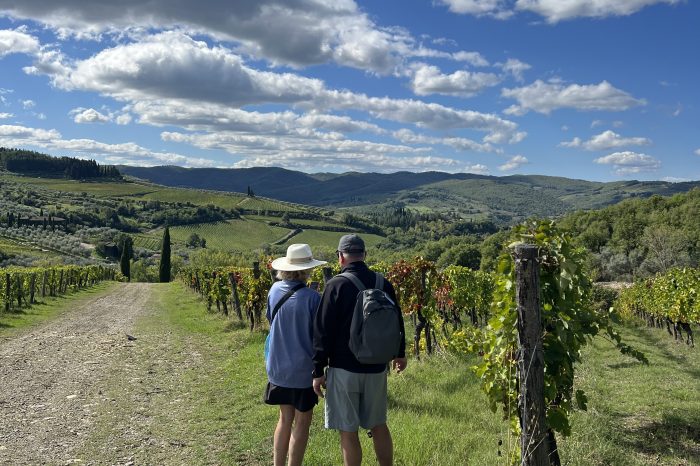
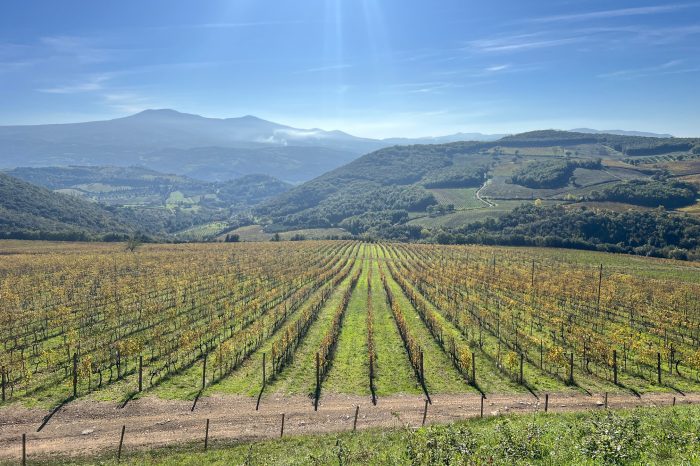
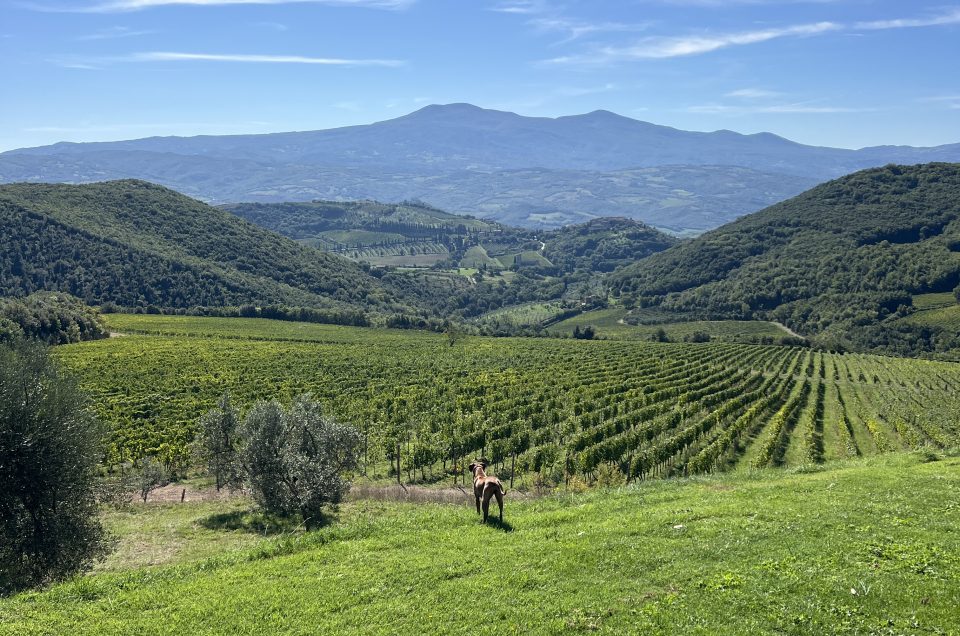
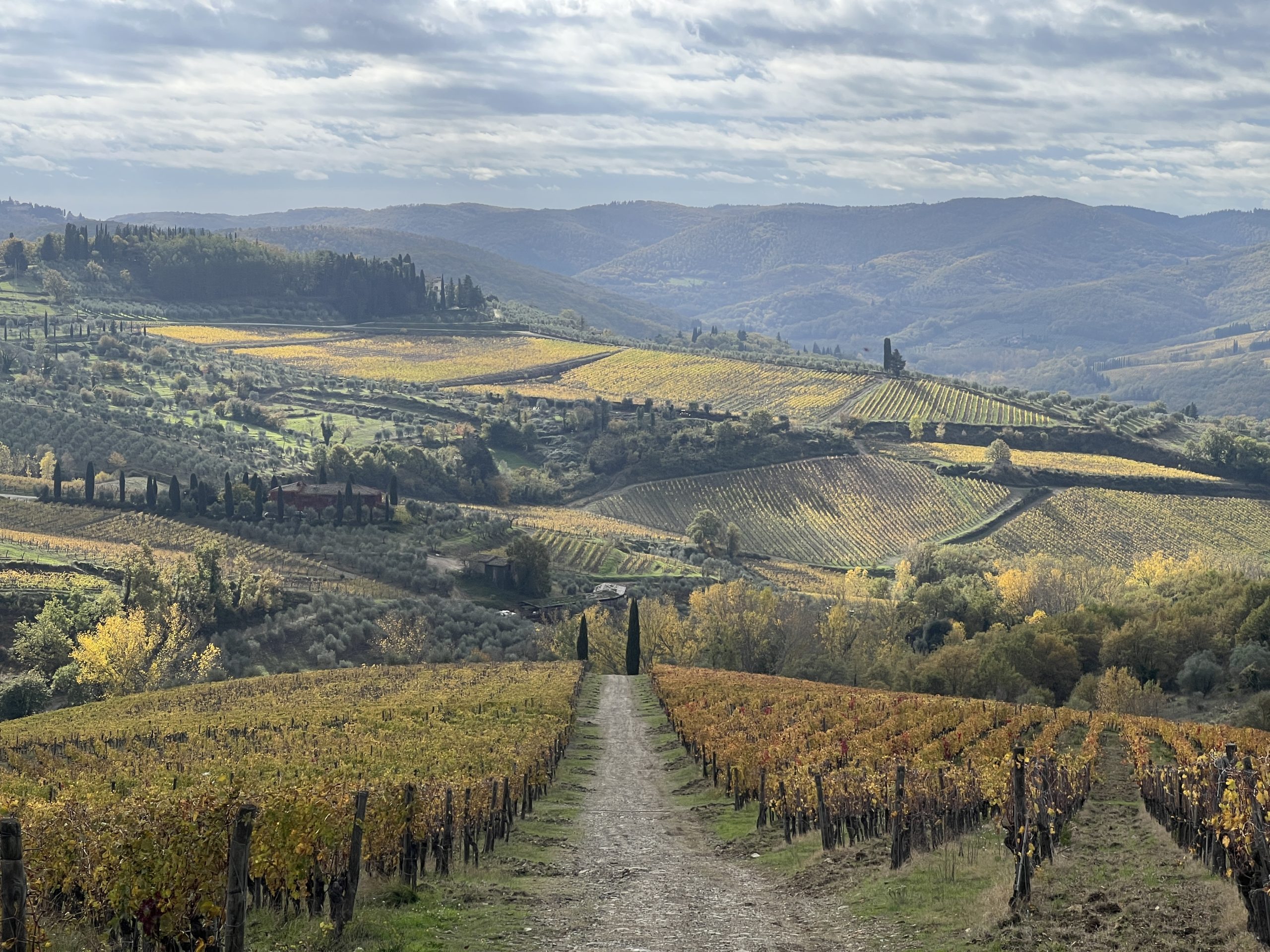
Without a doubt, the Chianti Classico wine zone — stretching between Florence and Siena — is the most iconic hiking destination in Tuscany. The area is a patchwork of dark cypress forests, terraced vineyards, stone farmhouses (fattorie), and narrow country lanes lined with wildflowers. Moreover, hiking here comes with a very Tuscan bonus: the trails connect directly to some of the finest wine estates in Italy, where a post-hike glass of Chianti Classico DOCG awaits you.
🥾 Trail Highlight: Greve in Chianti to Panzano Loop
This is one of the most rewarding hikes in all of Tuscany, passing through the historic butcher village of Panzano — home to the legendary Dario Cecchini — and through dense forest paths with sweeping vineyard panoramas.
📍 Start: Greve in Chianti📏 Distance: ~14 km⏱ Time: ~4h 30m↗ Elevation gain: 350m🎯 Difficulty: Moderate🚗 From Florence: ~40 min by car
🥾 Trail Highlight: Radda in Chianti to Volpaia Loop
A shorter but equally scenic route connecting two of the most beautifully preserved medieval villages in the Chianti Classico zone. Importantly, the trail passes through ancient oak forests and offers sweeping views over the Pesa Valley.
📍 Start: Radda in Chianti📏 Distance: ~10 km⏱ Time: ~3h↗ Elevation gain: 260m🎯 Difficulty: Easy–Moderate🚗 From Florence: ~55 min by car
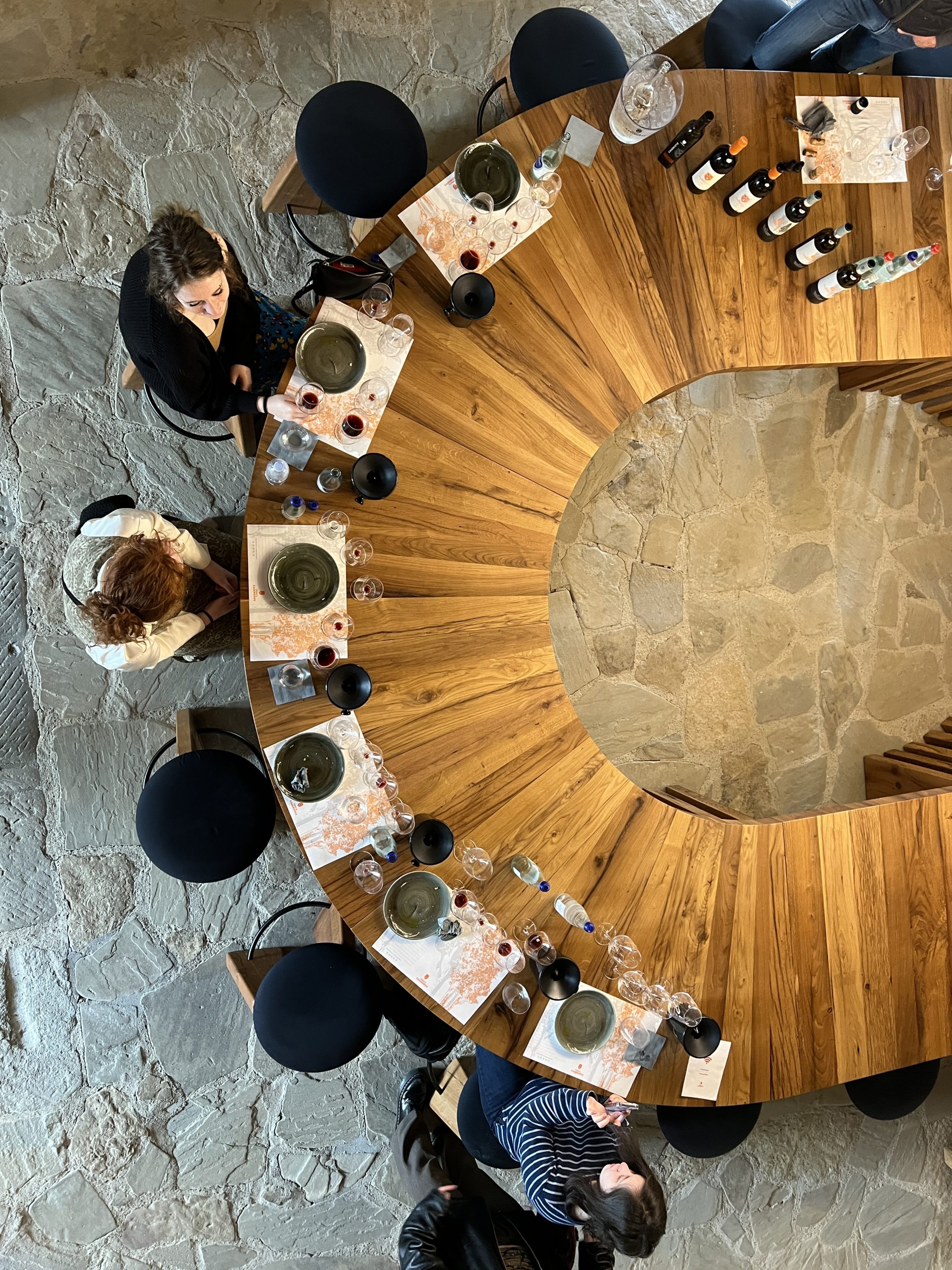
Additionally, Out of the Box Florence runs a full-day Hiking & Wine Chianti Classico Day tour that combines a guided trail with an exclusive wine tasting at a local estate. It is the perfect way to experience Chianti Classico with an expert local guide who knows exactly where to go.
Hiking in Val d’Orcia: A UNESCO World Heritage Landscape on Foot
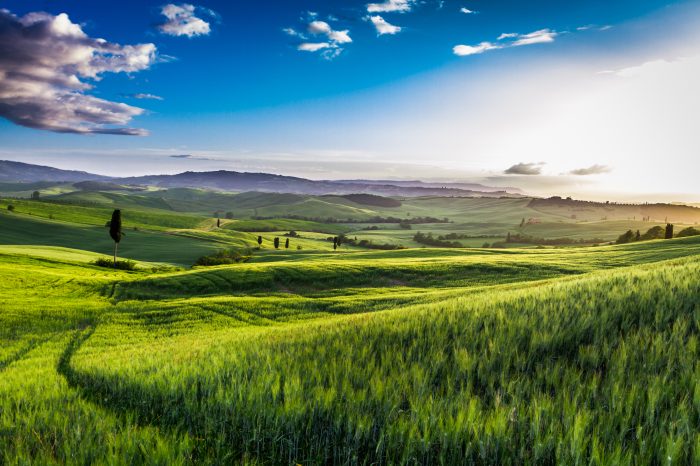
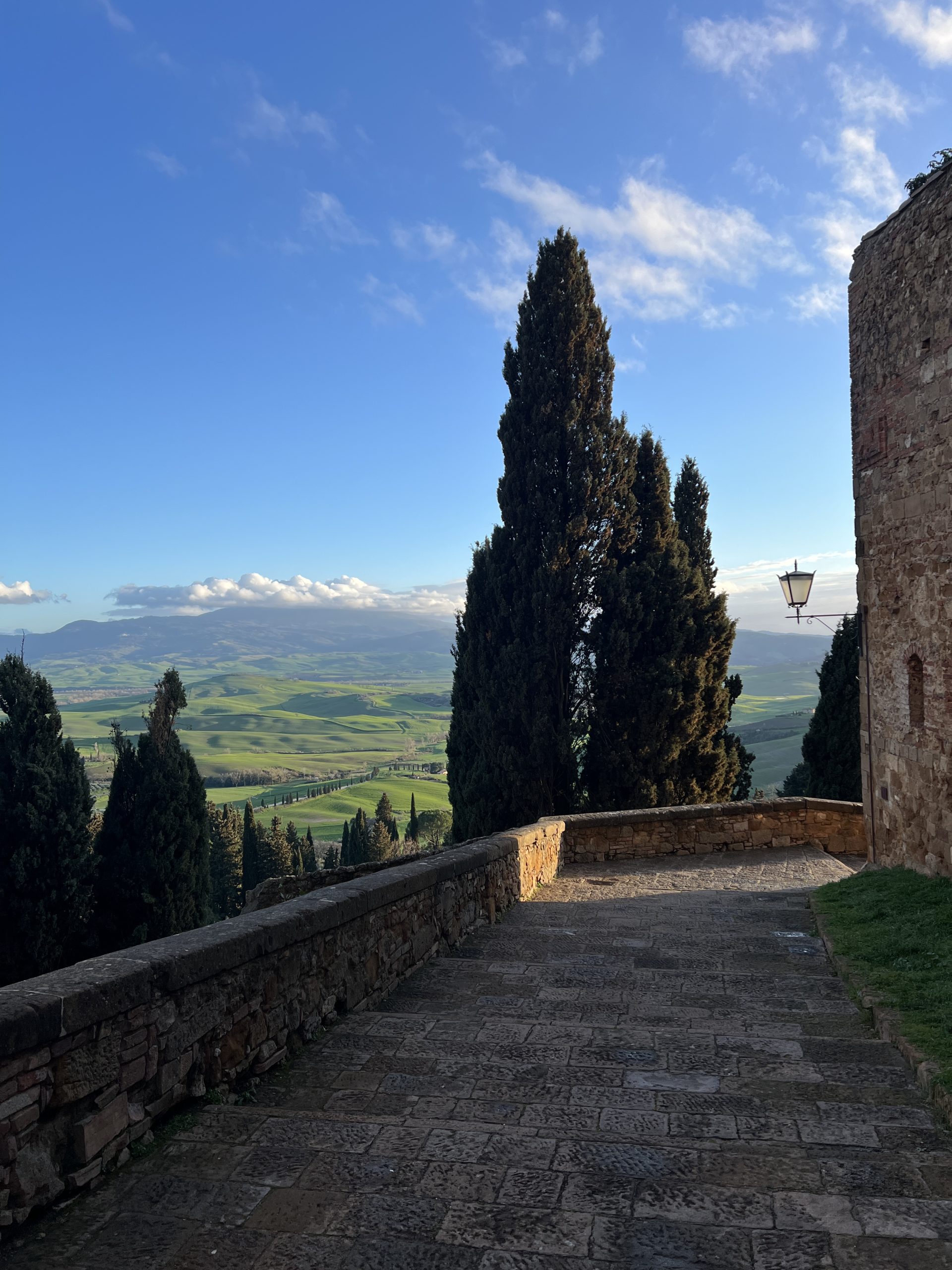
Moving south from Chianti, the landscape transforms dramatically. The Val d’Orcia — a UNESCO World Heritage Site since 2004 — is defined by its wide, rolling clay hills, solitary farmhouses perched on pointed ridges, and the iconic cypress-lined lanes that have appeared in countless Renaissance paintings. Consequently, hiking here feels like stepping directly into a living painting.
The area is centred around the towns of Pienza, Montalcino, and San Quirico d’Orcia, and it is also the spiritual home of Brunello di Montalcino — Italy’s most prestigious red wine. Therefore, a hike through the Val d’Orcia is not just an outdoor adventure; it is a full sensory journey through Tuscany’s finest wine country.
🥾 Trail Highlight: Via Francigena — Radicofani to San Quirico d’Orcia
This section of the ancient medieval pilgrimage route, the Via Francigena, winds through the most photographed landscapes of the Val d’Orcia. Specifically, the stretch near the Podere Belvedere farmhouse is one of the most iconic viewpoints in all of Italy — best seen at golden hour.
📍 Start: Radicofani📏 Distance: ~22 km one way⏱ Time: ~6h↗ Elevation gain: 480m🎯 Difficulty: Moderate🚗 From Florence: ~1h 45m by car
🥾 Trail Highlight: Montalcino Vineyard Loop
A scenic circular hike through the Brunello di Montalcino wine zone, traversing ancient oak forests, limestone ridges, and the terraced vineyards that produce one of the world’s most celebrated wines. As a bonus, the town of Montalcino itself is one of the best-preserved medieval fortresses in Tuscany.
📍 Start: Montalcino town centre📏 Distance: ~12 km⏱ Time: ~3h 30m↗ Elevation gain: 310m🎯 Difficulty: Moderate🚗 From Florence: ~1h 40m by car
In particular, our private Val d’Orcia tour includes a guided hike combined with a tasting of Brunello di Montalcino directly at the winery — an experience that is truly impossible to replicate on your own.
Hiking in Casentino: Ancient Forests, Hermitages and Hidden Tuscany
On the other hand, if you are looking for a wilder, more off-the-beaten-path hiking experience, the Casentino valley in eastern Tuscany is an absolute revelation. Nestled between the Apennine mountains and the upper Arno River, the Casentino is one of the greenest, most unspoiled valleys in all of Italy — and remarkably, it sits just 50 km east of Florence.
Above all, the star attraction is the Foreste Casentinesi National Park, a primeval beech and fir forest that has been protected since the Middle Ages by Camaldolese monks. The forest is so ancient and undisturbed that it is now recognised as one of the largest old-growth forests in Europe. In addition to the forest, the valley is home to two extraordinary sacred hermitages: the Eremo di Camaldoli and the Santuario della Verna, where Saint Francis of Assisi received the Stigmata in 1224.
🥾 Trail Highlight: Camaldoli Hermitage Forest Loop
A truly spiritual and scenic hike through ancient silver fir forest to the 11th-century Camaldolese hermitage. Notably, this trail passes through some of the most biodiverse woodland in Italy, rich with deer, wild boar, wolves, and golden eagles.
📍 Start: Camaldoli Monastery📏 Distance: ~11 km⏱ Time: ~3h 30m↗ Elevation gain: 390m🎯 Difficulty: Moderate🚗 From Florence: ~1h 10m by car
🥾 Trail Highlight: Poppi to Bibbiena via the Arno Valley
A lower-altitude valley walk connecting two of the Casentino’s most charming medieval towns. Furthermore, the route passes along the Arno River in its earliest stages — a magical contrast to seeing the same river flow through Florence further downstream.
📍 Start: Poppi (medieval castle town)📏 Distance: ~9 km one way⏱ Time: ~2h 30m↗ Elevation gain: 120m🎯 Difficulty: Easy🚗 From Florence: ~55 min by car
For this reason, the Casentino is a firm favourite on our Tuscany Adventure in Casentino tour — a full-day private experience combining forest hiking, local food, and the valley’s extraordinary medieval heritage.
Hiking the Crete Senesi: Tuscany’s Lunar Landscape
Equally spectacular, though very different in character, the Crete Senesi — literally “the Sienese clays” — is one of Tuscany’s most distinctive and photogenic landscapes. Located just south of Siena, this area is characterised by smooth, bare clay hillsides, rounded clay mounds (biancane), dramatic eroded ravines (calanchi), and the surreal sight of solitary cypress trees silhouetted against the horizon. As a result, photographers and landscape lovers rank it among their top destinations in all of Europe.
The best hikes in the Crete Senesi are gentle and panoramic, winding through small farming villages like Asciano, Murlo, and San Giovanni d’Asso — the truffle capital of Tuscany. Interestingly, autumn is the finest season to hike here, when the harvest light is golden and the black truffle season is in full swing.
Hikes Around Florence: Urban Trails and Hill Towns on Your Doorstep
Finally, do not overlook the remarkable hiking opportunities within reach of Florence’s city centre itself. The Tuscan hills that cradle Florence — the Fiesole hill, the Piazzale Michelangelo ridge, and the Arno Valley banks — offer scenic trails that combine city views, Renaissance villas, and lush olive groves, all accessible without a car.
Specifically, the classic hike from Florence to Fiesole (the Etruscan hilltop town overlooking the city) is a 20 km round trip that climbs through ancient pilgrimage routes, past Roman remains, and through the fragrant macchia of the Florentine hills. Similarly, the shorter Pian dei Giullari loop passes Galileo Galilei’s home and rewards walkers with extraordinary panoramic views over Florence’s terracotta rooftops and the Arno plain.
In short, Florence is not just a city to visit — it is a city to hike from. Our Florence Hike & Wine with Lunch tour is the perfect introduction, combining a guided half-day trail through the Florentine hills with a local wine tasting and lunch at a countryside trattoria.
Best Time of Year for Hiking in Tuscany
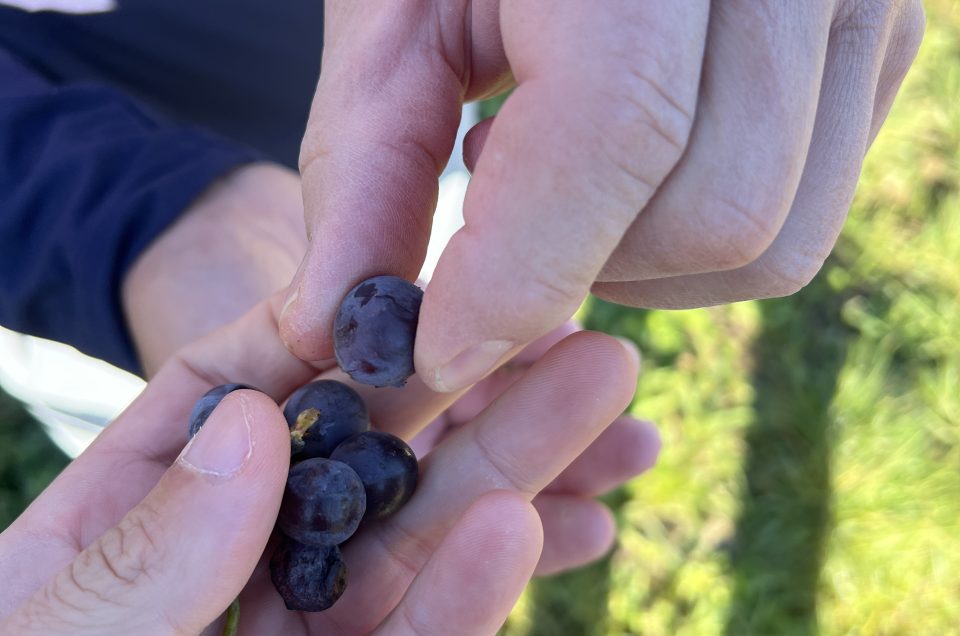
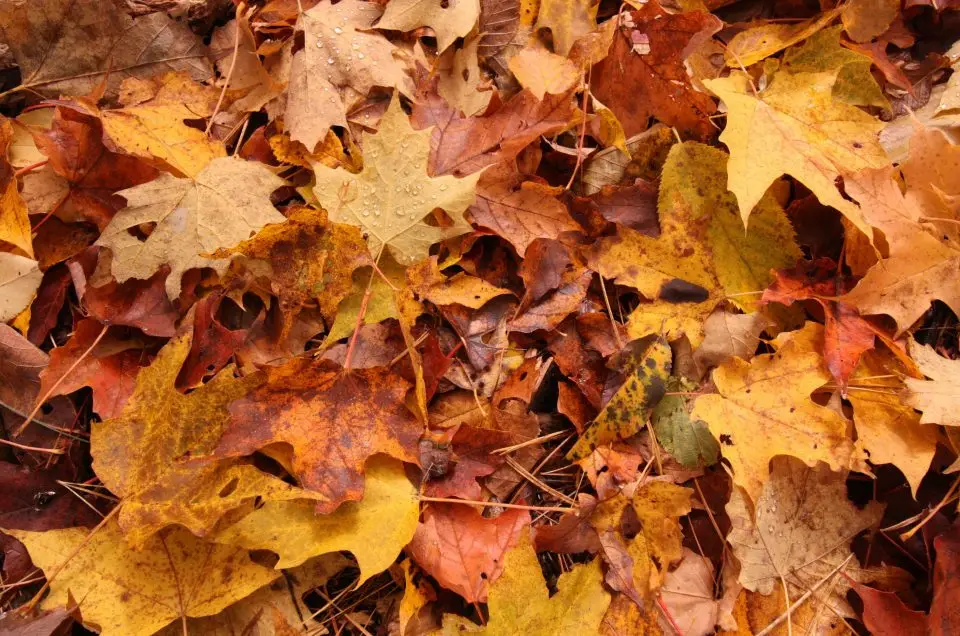
In general, the best seasons for hiking in Tuscany are spring (April–June) and autumn (September–November). During spring, the hills are carpeted with wildflowers, the vineyards are a vibrant fresh green, and the temperatures are ideal for all-day walks. Likewise, autumn offers stunning foliage colours, cooler air, and the added pleasure of the harvest season — olive picking, grape harvesting, and truffle hunting all happen during this period.
By contrast, summer (July–August) can be very hot for strenuous hiking, although early-morning starts and higher-altitude trails in the Casentino remain perfectly comfortable. Winter hikes, meanwhile, offer a rare solitude and — occasionally — the magical sight of snow on the Chianti hills or the Crete Senesi.
Ready to Hike Tuscany with a Local Expert?
At Out of the Box Florence, we design personalised hiking experiences across all of these landscapes — from a half-day trail near Florence to a multi-day trekking adventure through Chianti, Val d’Orcia, and Casentino. All tours are led by passionate local guides, fully licensed, and tailored to your pace and interests.
Explore Our Hiking Tours →
Frequently Asked Questions: Hiking Around Florence and Tuscany
What are the best hikes near Florence, Italy?
To begin with, the most popular hikes near Florence include the Florence-to-Fiesole trail (20 km), the Pian dei Giullari loop (10 km), and the Piazzale Michelangelo ridge walk (8 km). Beyond the city, the Chianti Classico trails between Greve in Chianti and Panzano are among the most scenic and rewarding day hikes in the region.
Is Tuscany good for hiking?
Absolutely. Tuscany is one of Italy’s premier hiking destinations thanks to its extraordinary variety of landscapes. In fact, within a 2-hour drive from Florence, you can hike through Chianti vineyards, primeval Casentino forests, UNESCO-listed Val d’Orcia valleys, the surreal Crete Senesi claylands, and the rugged Apennine ridges. The trail network is extensive and well-marked, and the combination of scenery, wine, and food makes every hike a unique cultural experience.
How do I get from Florence to Chianti Classico for hiking?
The easiest option is by car, as Greve in Chianti (the heart of the Chianti Classico zone) is just 40 minutes south of Florence along the SS222 Chiantigiana road. Alternatively, Busitalia/SITA buses run regularly from Florence to Greve in Chianti and Panzano. However, for the best experience, we recommend joining one of our guided Chianti hiking tours, which include transport from Florence.
What is the Casentino and why should I hike there?
The Casentino is a remote valley in eastern Tuscany, approximately 50 km from Florence, home to the Foreste Casentinesi National Park — one of Europe’s last old-growth forests. Not only does it offer exceptional wildlife (wolves, deer, eagles), but also two of the most extraordinary medieval sacred sites in Italy: the Camaldoli Hermitage and the Sanctuary of La Verna. It is the perfect destination for hikers who want to experience a Tuscany that feels completely off the tourist trail.
Can I hike in Val d’Orcia?
Yes, absolutely. Val d’Orcia is home to some of the most scenic hikes in Tuscany, including sections of the medieval Via Francigena pilgrimage route and circular trails around Montalcino, Pienza, and the famous cypress-lined lanes near Bagno Vignoni. In addition, many hikes pass directly through the Brunello di Montalcino wine zone, making a post-hike wine tasting a natural and very welcome conclusion to your walk.
What should I wear for hiking in Tuscany?
For most trails, lightweight trail shoes or sturdy walking boots are sufficient. In addition, bring a breathable layer for early mornings and higher elevations in the Casentino or Apennines, sun protection for exposed Chianti and Val d’Orcia paths, and always carry at least 1.5 litres of water per person. In short, Tuscany hiking is accessible and comfortable for most fitness levels — no technical mountaineering equipment required.
Start Your Tuscan Hiking Adventure with Out of the Box Florence
To summarise, the hikes around Florence and Tuscany are some of the most beautiful, varied, and rewarding in all of Europe. Whether you are drawn to the vine-scented trails of Chianti Classico, the cinematic valleys of Val d’Orcia, the wild forests of Casentino, the surreal claylands of Crete Senesi, or the hillside paths just outside Florence — there is a perfect trail waiting for you here.
At Out of the Box Florence, we are passionate local experts who live and breathe these landscapes every day. Consequently, when you hike with us, you do not just see Tuscany — you genuinely experience it. Contact us today to design your perfect Tuscany hiking adventure, tailored entirely around your interests, pace, and schedule.
Written by the team at Out of the Box Florence — fully licensed Tuscany travel agency & local hiking guides since 2020.